Category Archives: Artesanato

Cartões, carimbos e molduras

A este chamo o meu cartão Hello Kitty por causa das cores e bolinhas. É um bocado piroso mas divertiu-me

Comprei recentemente uma Sizzix Big Shot com o objectivo de usar com o Fimo mas entretanto não resisti a fazer uns cartões e tenho-me divertido imenso com aquilo.

Já não faço websites há algum tempo e acho que a parte do meu cérebro que lida com layouts, padrões e cores estava a precisar de exercí­cio e fazer cartões deu-me um gozo tremendo.

Como é costume para mim, comecei a investigar a questão mais a fundo e aprendi uma série de técnicas interessantes.

Também criei um board de cartões no Pinterest para juntar aqueles que gosto feitos por outras pessoas e que me possam servir de inspiração.

Carimbo feito com esponja cortada na Sizzix

Comprei mais umas cartolinas com padrões para juntar à s que já tinha em casa mas não consegui encontrar em loja nenhuma carimbos decorativos que não fossem só bonecada para crianças.

Resolvi experimentar fazer eu uns quantos (aproveitando para fazer mais um tutorial em video) mas mesmo assim a selecção é limitada.

Para além das borboletas, flores e corações, não tinha muitos elementos que pudesse utilizar como imagem central do cartão. Podia fazer eu ilustrações mas sinceramente não tenho muito jeito nem confiança nessa área. Fui então à  procura de ilustrações, clip-art, etc.

Como gosto imenso de ilustrações antigas, fiquei feliz ao encontrar o blog Digital Tuesday que publica ilustrações antigas que já não têm copyright e suas variantes digitais, com contorno limpo. Tem imensas flores, senhoras vitorianas e dos anos 20 que dão excelentes ilustrações centrais para os cartões. Para além disso vai dar imenso gozo pintar algumas das imagens.
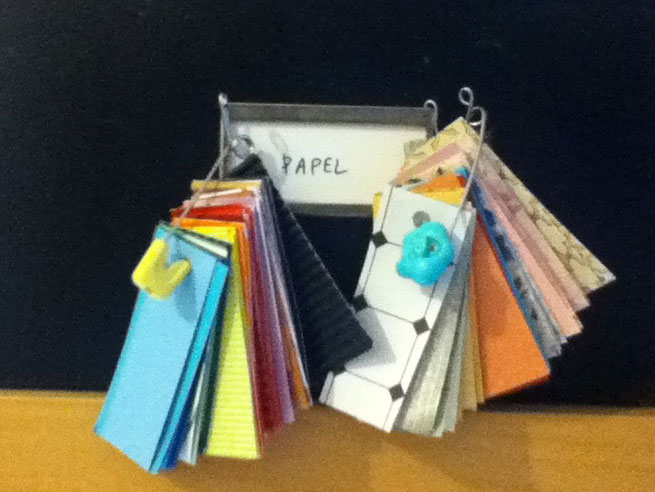
Samples de papel, penduradas na caixa para estarem sempre à  mão.

Outra pequena coisa que fiz e que acho que dá imenso jeito for um sampler dos papéis. Cortei um bocadinho de cada papel (das sobras ou das pontas que têm o código de barras para não estragar papel desnecessariamente), fiz um furo e enfiei num alfinete de dama. Assim tenho sempre à  mão a referencia de todos os papéis sem sem preciso andar com as cartolinas todas atrás a desarrumar a mesa.

Como entretanto ficámos de férias, virei a atenção para a decoração da casa. Comecei por criar fundos para as fotos que queria emoldurar com os mesmos papeis e fitas que usei nos cartões, tipo scrapbook simplificado.

Fundo em rosa e verde a condizer com a moldura

Depois passei para a decoração das paredes. Já nos mudámos há quase dois anos e ainda não tà­nhamos quase decoração nenhuma nas paredes.

Estava tudo planeado desde a mudança e até tinha os materiais praticamente todos mas a paciência é que ainda não tinha chegado.

Com alguma inspiração do Pinterest,  comecei a fazer “arte” caseira. Cortei uma série de circulos na Sizzix e  fiz um quadro a condizer com o padrão e cores das almofadas.

Para o corredor, que é comprido e estreito e não dá para por móveis, emoldurei uns posters de filmes para quebrar um bocado o branco contà­nuo das paredes.

Na sala estou a planear fazer uma parede com fotos da famà­lia. Ainda não acabei essa actividade porque ainda hoje estive a pintar montes de molduras. Eram todas de cores e formatos diferentes e por isso pintei tudo de preto para homogeneizar.


– New Locket Pendants

– The photo locket pendant seems to have been a popular idea so I’m posting two other examples.

The first is actually just a small photo frame and not a pendant. It was made for a couple’s 60th wedding anniversary.

The base color is silver and the texture was highlighted with gold and burnt umber paint. The gold gives it a very ornate and old-fashioned look but I thought it was appropriate for an older couple.

This time I used ribbon to join the two parts and an amethyst on the cover. I think it looked better with just the silver but it’s still an interesting color detail.

The back has a heart with the number 60 stamped on it, as a reference to the wedding anniversary.

The inside has pictures of the couple taken on their wedding day. The picture of the groom gave me some trouble because his skin was so dark and I couldn’t get a good contrast to make the features pop. After three tries I finally got it but the bride still looks better. Her hat, however, was another problem because it was white, against a white background so it looked like there was a bit of her head missing. I opted to paint it in with acrylic paint to define it better.

The second example is a pendant but it was done in black and white.

I won’t show the inside pictures because I didn’t ask permission from the client but it looks the same as the others apart from color.

The base was black and the texture highlighted with white acrylic paint. I used ribbon again for the hinge.

Actually, the hinge is made from three ribbons for stability. The center ribbon crosses the entire pendant so you can tie a bow on the other end to keep it closed.

The stone on the front is a hematite cabochon to go with the black and white theme.

I was very pleased with this last one. Even though it still has the antique looking texture, the black and white gives it a more modern feel.

– Picture Locket

– I’ve been playing around with polymer clay again and I liked the idea of transferring black and white images onto the clay. It’s a simple process, though you have to practice a little bit because it’s easy to rub the ink off along with the paper if you’re not careful, and the result is an antique-looking image.

You can make just a pendant out of if and I thought about using pictures of my children to try it out, but since I have two I didn’t want to have to choose just one and getting a picture of the both of them is not an easy feat.

All this thinking got me to the conclusion that the best option for what I had in mind would be to make an old-fashioned locket since I could place both pictures inside. I was inspired by a picture of an icon box (you can check out my inspiration board on Pinterest) and made my locket out of copper-colored polymer clay.

I textured and aged it with acrylic paint and applied a gloss varnish. The pictures were transfered onto light flesh-tone clay. I used a natural stone cabochon on the cover, thread to bind both pictures and a lobster clasp to close it and also on top to attach it to a necklace, key-chain or anything else I want.

It turned out a bit larger than I had planned at first – 4 cm – because I didn’t anticipate the inside frame when I started making it, but since it’s polymer clay, it’s still quite lightweight. I plan to make a simpler version next and maybe a round one instead of square.

I think these lockets are a great idea for moms, especially if they like antique-looking objects, since they can have an original piece of jewellery and also pictures of their kids all in one.

Video: moldes de silicone para usar com Fimo – Silicone mold tutorial video

Estive ontem a fazer um pequeno và­deo que ensina a fazer moldes de silicone de pequenos objectos que se podem depois usar para fazer cópias em Fimo, resina ou PMC.

O và­deo está falado em inglês mas penso que a imagem é clara o suficiente mesmo para quem não compreende bem a lingua. O material que uso no và­deo chama-se Siligum e é um silicone em duas partes que é preciso misturar em quantidades iguais. O objecto deve ser pressionado sobre o silicone no espaço de um minuto desde que se começa a misturar os dois componentes porque o material endurece muito depressa.

Espero que gostem do và­deo.

– I made a video on how to make silicone molds out of small objects to use with polymer clay or resin.

I use Siligum, a two part silicone compound that dries quickly and makes a flexible mold. This material makes a clear impression and captures every detail of the object being molded. You can use the mold to make duplicates of the objects in polymer clay, metal clay or resin. I focus on the difference between molding a thin or a thicker object and how to fix a hole in your mold.

I hope it’s helpful.

Embellishing plain beads

Plain round glass beads can be pretty boring by themselves but we do tend to stock up on them because they add color while allowing more elaborate beads to pop. Unfortunately, sometimes you find yourself looking at a large quantity of those plain beads with little more to go on.

At such a time, I decided to consider it a challenge rather than a problem and made it a project to finding ways to embellish plain beads with wire and bring them out into the spotlight. I used bead cages, coils and other wire frames and mixed wire colors to add interest to the finished pieces.

In the first image you have a bracelet made from oval beads wrapped in coiled green wire (a shade lighter than the beads to make it stand out) and then wrapped again in copper wire with some seed beads thrown in. It’s really simple to make but visually it’s very effective.

The second picture shows a pair of earrings made from lampwork square beads. They’re beautiful by themselves but become more captivating through the use of a large coil at the end of the wrapped loop – a variation in the tiny coils used to finish off the wire. The coils add interest to a plain square or coin shaped bead and they also prevent the beads from turning so it’s a useful method to use in necklaces and bracelets as well.

Bead cages and weaving with colored wire turn plain blue beads into something special. – Plain round glass beads can be pretty boring by themselves but I do tend to stock up on them because they add color while allowing more elaborate beads to pop. Unfortunately, sometimes I find myself looking at a large quantity of those plain beads with little more to go on.

At such a time, I decided to consider it a challenge rather than a problem and made it a project to finding ways to embellish plain beads with wire and bring them out into the spotlight. I used bead cages, coils and other wire frames and mixed wire colours to add interest to the finished pieces.

In the first image (at the top) you have a bracelet made from oval beads wrapped in coiled green wire (a shade lighter than the beads to make it stand out) and then wrapped again in copper wire with some seed beads thrown in. It’s really simple to make but visually it’s very effective.

The second picture shows a pair of earrings made from lampwork square beads. They’re beautiful by themselves but become more captivating through the use of a large coil at the end of the wrapped loop – a variation in the tiny coils used to finish off the wire. The coils add interest to a plain square or coin shaped bead and they also prevent the beads from turning so it’s a useful method to use in necklaces and bracelets as well.

Bead cages and weaving with coloured wire turn plain blue beads into something special, as you can see in the last example.

– Bijutaria em FimoBijutaria em Fimo

colar marinho (detalhe)

Actualizei a loja com diversas peças de bijutaria esculpida em Fimo que tenho andado a realizar ao longo dos últimos meses. Espero que visitem e gostem das peças.

Tenho aprendido imenso sobre esculpir em Fimo e descobri que gosto muito de o fazer. A parte mais atraente é poder usar cor à  vontade e construir componentes à  medida das necessidades da peça. Aqui não há o problema de faltar mais uma conta para terminar o design perfeito – se for preciso faz-se mais uma.

As peças que mais gosto de fazer são os colares, pela complexidade, e graças a uns tutorials fabulosos da Christi Friesen consegui fazer umas peças muito giras. Depois de fazer o colar da selva seguindo o tutorial (tirando a flor decidi fazer em vez do pavão sugerido) desenhei o colar marinho utilizando a mesma técnica base mas criando do nada todas as formas e texturas e é a minha peça favorita do momento.

colar marinho (detalhe)

Actualizei a loja com diversas peças de bijutaria esculpida em Fimo que tenho andado a realizar ao longo dos últimos meses. Espero que visitem e gostem das peças.

Tenho aprendido imenso sobre esculpir em Fimo e descobri que gosto muito de o fazer. A parte mais atraente é poder usar cor à  vontade e construir componentes à  medida das necessidades da peça. Aqui não há o problema de faltar mais uma conta para terminar o design perfeito – se for preciso faz-se mais uma.

As peças que mais gosto de fazer são os colares, pela complexidade, e graças a uns tutorials fabulosos da Christi Friesen consegui fazer umas peças muito giras. Depois de fazer o colar da selva seguindo o tutorial (tirando a flor decidi fazer em vez do pavão sugerido) desenhei o colar marinho utilizando a mesma técnica base mas criando do nada todas as formas e texturas e é a minha peça favorita do momento.

Polymergence Newsletter – edição de Abril – Polymergence Newsletter – April edition

Há umas semanas fui contactada por uma simpática senhora chamada Charlene Therien a pedir para incluir uma foto dos meus brincos de ovo estrelado na edição de Abril da Newsletter da International Polymer Clay Association, chamada Polymergence.
Fiquei feliz por poder contribuir uma peça e escrevi um pequeno parágrafo para acompanhar a foto.

fried_eggs_dee_02

Todos os trabalhos desta edição são baseados em ovos mas numa grande variedade de estilos, mostrado mais uma vez como a cerâmica plástica pode ser tão versátil. Os meus brincos destacam-se das restantes peças pelo facto de serem os únicos a ilustrar o interior do ovo em vez de se basearem na sua forma exterior mas isso não implica que sejam a peça mais interessante ou mais bonita.

Podem ler a newsletter aqui, e ver todas as outras fabulosas criações de diversos talentosos artistas de cerâmica plástica. – A few weeks ago I was contacted by a nice lady called Charlene Therien, asking if she could include a picture of my Fried Egg earrings on the April edition of the International Polymer Clay Association Newsletter, Polymergence.
I was happy to contribute and wrote a small paragraph to go with the picture.

fried_eggs_dee_02

All the pieces presented in this issue are egg-related but in a wide range of styles, showing how versatile polymer clay can be. My earrings stick out from the rest because they were the only item depicting the inside of the egg instead of being based on the outer egg shape but they’re hardly the most interesting or attractive piece.

You may read the newsletter here, and see for yourself all the fabulous creations by several talented polymer clay artists.

– Chaos necklace variation

– A while back I bought Eni Oken’s chaos necklace tutorial. I’ve always loved her jewelry and wanted to try some of her designs. I followed the instructions and made my turquoise version but I didn’t want to use the charms, something that is very much Eni’s signature element. I tried using spiral bezels on top and bottom of every stone but the result was not satisfactory. I liked the look of the necklace but the spirals moved around more than they should and didn’t stop the stones from turning.

It bugged me for a long time until one day I just took the necklace apart and remade it with a few changes. I used “S” spirals connecting the top and bottom frame at the front of the stone instead of two separate pieces and I attached the second half of the frame further up so that it doesn’t need the last pass with the decorative beads to keep it steady.

In the end I decided not to add the beaded frame because it makes the necklace a bit over the top. If I leave it simpler it goes from a party piece to something you can wear on more informal occasions and I like that. Besides, I can always add beads later if I want to.

– Adventures in Polymer Clay

– When it comes to polymer clay I’m still very much a beginner. I’ve made a few things I like but haven’t developed enough of a technique to be able to make really perfect pieces. Not that perfection is always important. As with everything handmade, sometimes leaving your mark is actually a plus and, like everything else, the more you work the better you get.

I’ve picked up polymer clay again now because I wanted to do a specific pendant with color gradients. When I picked up the clay I noticed it had gotten really hard and flaky – it had been at least a year since I last used it for anything so that was no surprise. It was just a bit frustrating because instead of making my pendant I spent days reconditioning clay before I could get anything else done.

To recondition the clay I tried using baby oil, sewing machine oil and even a glycerin lubricant. Each seemed to work fine and none of the initial experiments seemed to have a negative effect on the curing process or the end result. I decided to stick with baby oil because it seemed the most harmless.

This was my reconditioning technique: I hammered the dry clay with a plastic hammer until it was reasonably flat and then rolled it on the pasta machine. It came out in flaky bits at the bottom so I added some baby oil and mushed it all into a ball. I let it sit for a bit (while rolling another color in the pasta machine, for example) and then come back to it, hammer it again and roll it again. After rolling it in the pasta machine about 10 times the clay started to get to the right consistency one more. Once or twice I added too much oil and it got really sticky so I let it sit for a few hours or overnight and it was fine again.

So after a day or two of this I finally got the pendant done and decided I should stick with the clay for a while longer, learn a few things and use up the leftover clay so it won’t get crumbly again.

I started by making a necklace from a tutorial by clay artist Christi Friesen. I had the tutorial for ages because I love the organic look of those leaves, even though it’s not a look I would have ever come up with on my own (I naturally tend towards more geometrical and abstract patterns) but I never got around to trying it out. I like the way the necklace turned out and I think I managed the general feel of the thing but some of the tendrils got a bit more squished than I would have liked and I’m sure it will turn out better if I make it again. I didn’t have mica powder to brush over the leaves so I used a loose powder eye shadow that worked just as well.

The matching earrings I made later turned out a little better.

At this point I wanted to explore color palettes so I picked up the last book I bought on the subject called Polymer clay color inspirations. It’s a really good book to help you brush up on color theory. I studied that in college and I’ve always been rather intuitive when it comes to color but it’s always helpful to refine some concepts once in a while. Also, I’ve used color in webdesign for many years but that is totally different from mixing clay in order to come up with a specific tone. It’s harder to fix mistakes, for one. The theory is the same but to instinctively know how much magenta or yellow to add is a trial and error process.

I wanted to make an Art Nouveau pendant and a flower cane seemed like a fun way to do it. Unfortunately I didn’t like the end result so I scrapped the cane. While I was cutting up the clay I decided to roll some of it that had an interesting color scheme through the pasta machine and ended up making a pendant and some earrings out of it.

I like the earrings because they look like a painting. I textured the surface to add a little extra interest.

After this failed attempt I decided to stick to color schemes that can’t go wrong and went with warm colors and a different technique.

I made a bunch of sheets in tones of yellow, orange, red and burgundy, cut circles out of each, stacked them up, extruded the resulting log that I then cut into nine parts, arranged them into a cube and cut that into slices. From these square slices I made a brooch and some earrings that remind me of Kandinski’s farbstudie quadrate painting (only not so colourful).

You can still tell where the seam is because I didn’t want to mess with the surface of the pendant too much. Apart from that I think it works.

Next I think I’m going to tackle surface textures. I just need the picture of the finished product to pop up in my head first because even when I’m working on book or tutorial projects I never like to do something that’s exactly like the example given. What’s the point in that? I believe you should always put a bit of yourself in everything you do even if it’s based on someone else’s work.

Anéis de prata – Silver rings

Tenho andado a trabalhar em anéis de prata. O primeiro foi feito a partir de fio meio redondo grosso de Argentium. Este tipo de fio é muito usado para fazer a base dos anéis mas resolvi esmagar e arredondar as pontas para lhe dar um aspecto diferente. Um anel feito com fio meio redondo é plano no interior e redondo por fora. Também podia ter usado fio redondo martelado mas nesse cado ambos os lados – interior e exterior – teriam ficado planos.

I’ve been working on silver rings. The first one was made with thick D wire, standard for rings, but with the ends hammered and filed round. I used D wire instead of round because this way I can have the inside of the ring flat while the outside stays rounded. I could also hammer round wire to make it flat (like in the next ring) but then the outside would also be flattened.

O anel seguinte foi feito da mesma forma mas com fio redondo. Martelei-o no centro para espalmar e depois martelei também as pontas mas a um ângulo de 90 graus em relação ao centro. O fio era mais longo para permitir que as pontas se cruzem no topo o que criou uma espécie de “orelhas de coelho”. Uma variação a este tema seria criar um nó no topo – algo que também planeio experimentar. A desvantagem é que com um nó o anel deixa de ser ajustável por isso este modelo é mais versátil, especialmente quando não é feito para uma pessoa especàfica.

This following ring was made much in the same way but using round wire. I hammered it in the center to make it flat and then hammered the end at a 90 degree angle and filed the ends round. This wire was longer to allow the ends to overlap creating the ‘bunny ears’. A variation on this theme would be tying a knot at the top – something I’m planning on trying as well. The downside is that with a knot the ring is no longer adjustable, so this model is more versatile, especially when you don’t make it for yourself.

O anel abaixo foi feito para o meu marido. Começou por ter uma banda larga e aberta porque eu não sabia o tamanho dele e queria que fosse surpresa, logo tinha de ser ajustável. Ele queixou-se que o anel era largo demais e por isso alterei-o, ajustando o tamanho, soldando atrás e afunilando o anel de forma a ser mais fino atrás do que à frente. A textura foi feita com um martelo, chave de fenda e um esfregão verde. Carimbei as letras e oxidei com fàgado de enxofre. As letras não ficaram tão escuras como eu queria por isso pintei o fundo com um marcador permanente para acentuar.
No final passei com um esfregão de palha de aço fininho para retirar a patina do topo mas deixando-a nas zonas mais profundas, acentuando a textura.
Acho que a textura dá ao anel um ar masculino e gostei do resultado.

This ring below I made for my husband using silver sheet. After cutting the sheet I filed the ends round and then textured the surface using a hammer, screw-driver and a greed scrubbing pad. I stamped the letters and then I oxidised it with liver of sulfur. The letters didn’t come up as dark as I wanted (probably because I keep the punches oiled to prevent them from rusting) so I used a permanent marker to darken the grooves.
After shaping the ring I polished it with steel wool, leaving the dents dark to accentuate the texture.
The texture and width give the ring a masculine feel and I was pleased with the result.

O anel final foi uma variação da primeira versão do anterior. Usei a mesma base larga ajustável com cantos arredondados mas fiz uma textura mais subtil e não oxidei. Na frente do anel soldei uns fios com bola na ponta para servirem de âncora Dobrei esses fios de forma a formar pequenos arcos. Depois de branquear e limpar o anel prendi lascas de ametistas às “âncoras” com fio de 0,3 mm até cobrir toda a área, criando uma camada decorativa de lascas de ametista. No final poli o anel com rouge e a minha dremel. Devia ter polido antes de prender as pedras mas não tinha um projecto e fui improvisando por isso alguns dos passos ficaram fora de ordem. Da próxima vez sai melhor. Por exemplo, teria sido mais fácil soldar ambas as pontas dos fios à base, criando logo arcos mas só pensei nisso quando já ia a meio. Um bocado idiota, eu sei.

For the final ring I just expanded on the previous. I used the same silver sheet base with rounded corners but made a more subtle texture and didn’t oxidise. Then I soldered some wire ends with a ball tip along the front of the ring. After pickling and cleaning it, I weaved thin silver wire with amethyst chips around the wire ends, using them as supports. When the front was covered I bent the wire tips into an arch so that the ball ends were touching the base of the ring and then polished it with jeweller’s rouge and a Dremel. I should probably do the polish and even bending the tips before attaching the beads, but I was improvising a bit so the order of steps didn’t come out quite as perfect as it should be, but the end result is quite striking and next time I’ll find an easier way to do it – for example: it would have saved time to solder a single wire across the base instead of two tips but I didn’t think of that until I was halfway through. Silly, hum?

– Stacked bead earrings

– I wanted to use gemstone chips to make some earrings. The simpler way is to stack them onto a simple ear wire with a hammered end.

Unfortunately, most chips have very small holes and the garnet chips were the only ones that would fit. The other option is to wrap them around the ear wire like some previous earrings I made with small rondelles.

In order to prevent the beads from slipping out the other end, I hammered the curve slightly (after I took this picture).

The stacked chips idea didn’t quite work but I liked it, so I made a couple more earrings with the same feel but using glass rondelles.

These two examples have a different feel because the rondelles are all the same size and shape, creating a much tidier par of earrings, unlike the chips that give the piece a rougher, more natural and casual look. They still look good, though.

The red ones are my favorite of the two. The underside of the beads has an AB coating so they change color between a lighter or darker red according to the light.

– Novos brincosNovos brincos

– Brincos simples, forjados a partir de um único arame com uma ponta martelada para segurar as contas, que são empilhadas em coluna. As contas irregulares (chips) de pedras naturais ou as contas redondas achatadas (rondelles) são as que ficam melhor neste modelo. As contas achatadas, de forma regular, dão um ar mais sóbrio enquanto que o uso de contas irregulares ou até com bicos são mais informais. Estes brincos são um bom exemplo de como é possível fazer algo simples mas com impacto visual. Também é possível jogar com o comprimento dos brincos e número de pedras para efeitos diferentes.

Brincos simples, forjados a partir de um único arame com uma ponta martelada para segurar as contas, que são empilhadas em coluna. As contas irregulares (chips) de pedras naturais ou as contas redondas achatadas (rondelles) são as que ficam melhor neste modelo. As contas achatadas, de forma regular, dão um ar mais sóbrio enquanto que o uso de contas irregulares ou até com bicos são mais informais. Estes brincos são um bom exemplo de como é possível fazer algo simples mas com impacto visual. Também é possível jogar com o comprimento dos brincos e número de pedras para efeitos diferentes.